
Geo Controller provides geographic tag replacement that can be used alongside The SEO Framework to create location-aware SEO titles and meta descriptions.
By combining Geo Controller’s IP geolocation data with The SEO Framework’s metadata settings, you can personalize supported SEO output using geographic placeholders such as %%country%%, %%city%%, and %%region%%.
This functionality can be useful for international websites that want to adapt selected metadata to a visitor’s detected location. However, location-dependent SEO metadata requires careful configuration, particularly when search engine indexing, page caching, and social media previews are involved.
How the Integration Works
Geo Controller includes a geographic tag replacement mechanism that processes supported placeholders in the generated WordPress HTML.
When The SEO Framework preserves a supported geographic placeholder in its generated metadata, Geo Controller can replace it with information associated with the current visitor’s IP address.
For example, %%country%% can become United States for a visitor detected in the United States or United Kingdom for a visitor detected in the United Kingdom.
This mechanism is separate from The SEO Framework’s internal metadata generation system. Geo Controller geographic placeholders are not necessarily registered as native variables or available through a dedicated selector in The SEO Framework’s interface.
Compatibility depends on whether the installed version of The SEO Framework preserves these placeholders in its generated HTML output.
How to Use Geo Controller with The SEO Framework
- Install and activate The SEO Framework.
- Install and activate Geo Controller.
- Verify that Geo Controller is detecting geographic information correctly.
- Open a WordPress post or page and locate The SEO Framework’s SEO settings.
- Find the available SEO title or meta description fields.
- Enter a supported geographic placeholder, such as
%%country%%, as literal text within your metadata. - Save or update the page.
- Inspect the generated HTML source to confirm that the placeholder has been replaced with the expected geographic value.
Note: The available metadata fields and interface may vary between versions of The SEO Framework. Some fields may sanitize, transform, or remove unsupported placeholders before the final HTML is generated.
Available Geographic Tags
Geo Controller provides geographic placeholders that can be used in supported WordPress output.
Common examples include:
| Geo Controller Tag | Description |
|---|---|
%%country%% |
Detected visitor country name. |
%%country_code%% |
Two-letter country code. |
%%city%% |
Detected visitor city. |
%%region%% |
Detected region or state. |
%%continent%% |
Detected continent name. |
%%currency%% |
Currency code associated with the detected location. |
The availability and accuracy of geographic values depend on the information returned for the current request.
For a complete reference, visit the Geo Controller Tags documentation.
Using Geographic Tags in SEO Metadata
Geographic placeholders can be combined with ordinary text to create location-aware metadata, provided they are preserved in the final HTML generated by The SEO Framework.
Example: Geographic SEO Title
Suppose your company provides services internationally.
You could use the following title template:
Professional Services in %%country%% | Example Company
For a visitor detected in the United States, the resulting title may be:
Professional Services in United States | Example Company
Example: Geographic Meta Description
You could also use a geographic placeholder in your meta description:
Explore our products and services available in %%country%%. Contact our team to learn more.
For a visitor detected in the United Kingdom, the resulting description may become:
Explore our products and services available in United Kingdom. Contact our team to learn more.
These examples demonstrate geographic text replacement. They do not guarantee that search engines will index or display each geographic variation.
The SEO Framework Settings Example
The following screenshot illustrates the historical use of Geo Controller geographic placeholders with The SEO Framework.
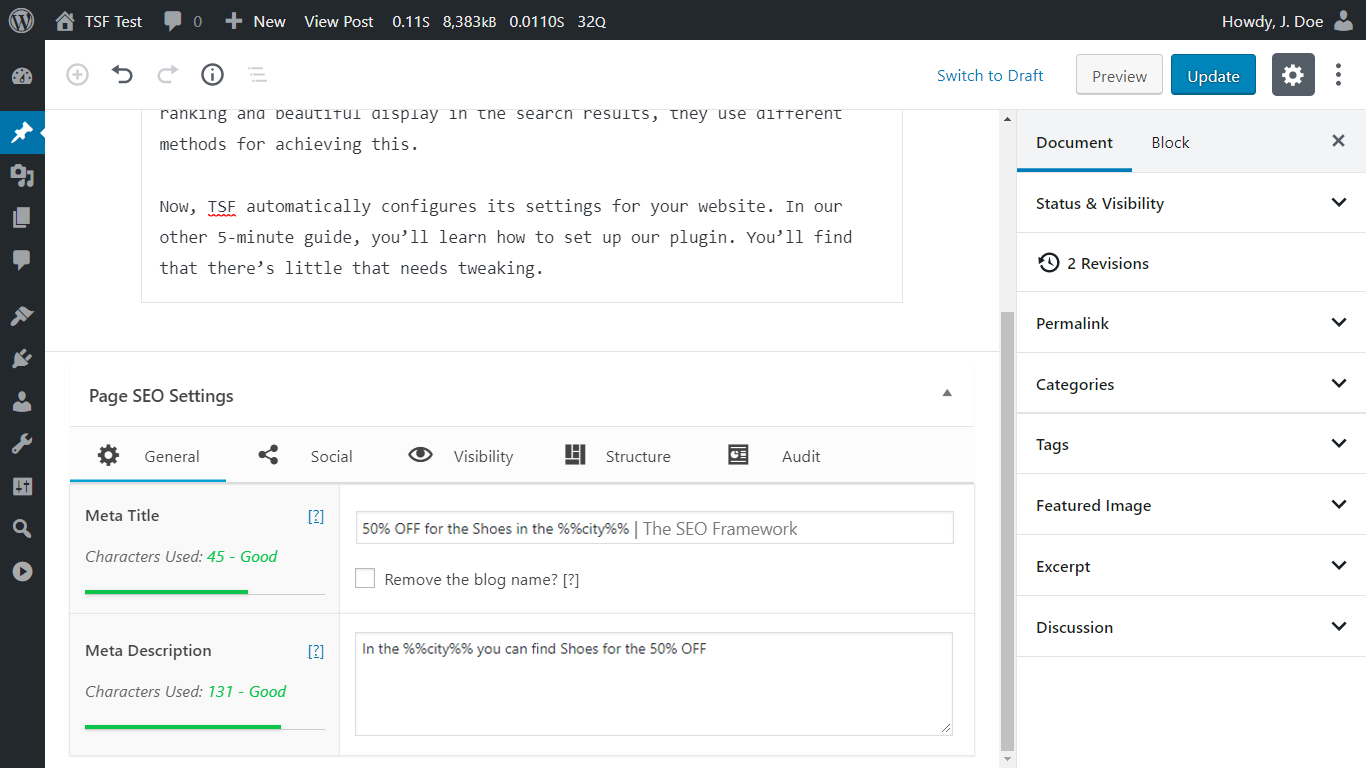
The current interface may differ from the version shown in this screenshot. Always verify the generated HTML when using modern versions of The SEO Framework.
How to Verify Geographic Metadata
Do not rely exclusively on the SEO settings displayed in the WordPress administration area.
To verify the generated metadata:
- Save the post or page containing your geographic placeholder.
- Open the public page in your browser.
- Use View Page Source to inspect the server-generated HTML.
- Locate the
<title>element or<meta name="description">tag. - Confirm whether the geographic placeholder was replaced with the expected value.
- Repeat the test using different visitor locations where possible.
If the placeholder remains unchanged, verify that The SEO Framework preserved it and that Geo Controller processed the generated HTML.
If the placeholder is missing entirely, The SEO Framework may have removed or transformed it before Geo Controller could perform the replacement.
Important SEO Considerations
Geographic metadata personalization should not be confused with a complete international SEO strategy.
Search engines may crawl your website from locations that differ from those of your intended audience. Consequently, they may encounter only one geographic variation of your metadata.
For example, a search engine crawler connecting through a United States IP address may receive metadata intended for visitors in the United States, even when the same page generates different metadata for European visitors.
This does not mean that search engines will automatically index or rank each geographic variation independently.
International SEO and Google Search
For websites targeting different languages or countries, dedicated regional URLs and appropriate hreflang annotations are generally more reliable than depending exclusively on IP-based metadata personalization.
Google provides additional guidance in its documentation on locale-adaptive pages.
Geographic placeholders should complement a well-planned international SEO strategy rather than replace established indexing and localization practices.
Avoid Misleading Geographic Metadata
Location-specific titles and descriptions should accurately represent the content and services available on the page.
For example, a page should not advertise services in a particular country if the business does not actually provide those services there.
Avoid generating geographic claims that cannot be supported by the page’s visible content.
Page Caching and Dynamic Metadata
Geo Controller’s geographic tag replacement operates during WordPress HTML generation.
When a caching plugin, reverse proxy, or content delivery network stores the generated HTML, later visitors may receive the same cached metadata regardless of their actual location.
For example, a page cached with a title containing United States may continue displaying that title to visitors from other countries.
Geo Controller’s general HTML tag replacement does not automatically bypass full-page caching or create separate cache entries for each geographic location.
Review your caching strategy before enabling location-dependent metadata on production websites.
Social Media Sharing and Link Previews
The SEO Framework can generate metadata used by social platforms, including Open Graph information.
However, social networks generally retrieve page metadata using automated crawlers rather than the browsers of individual users.
Consequently, geographic placeholders may be replaced using the crawler’s detected location instead of the location of the person sharing or viewing the link.
Social media platforms may also cache previously retrieved metadata, preventing different geographic variations from appearing in individual link previews.
For predictable social sharing results, consider using stable titles and descriptions instead of visitor-specific geographic metadata.
Privacy and Sensitive Information
Not every geographic or technical property should be included in publicly accessible SEO metadata.
Avoid exposing visitor IP addresses, precise coordinates, network identifiers, or other potentially sensitive information through SEO titles, meta descriptions, and social metadata.
Broad geographic information, such as a country or region, is generally more appropriate for public-facing metadata personalization.
Recommended Best Practices
- Use geographic placeholders only when the resulting metadata is accurate and relevant.
- Verify that The SEO Framework preserves custom placeholders in its generated HTML.
- Prefer stable metadata for important organic search landing pages.
- Use dedicated regional URLs and
hreflangwhere appropriate for international SEO. - Inspect the actual HTML source rather than relying exclusively on the WordPress editor.
- Review full-page caching, reverse proxy, and CDN behavior.
- Test social media previews when using geographic metadata.
- Avoid inserting sensitive visitor information into public metadata.
- Do not assume geographic personalization will improve search rankings.
For Developers
Geo Controller provides a general HTML tag replacement mechanism for supported geographic properties.
In the publicly available implementation, the CFGP_Public::output_buffer_callback() method processes geographic placeholders using information supplied by the Geo Controller API.
Developers can customize the data used by the general tag replacement mechanism through the cfgp/render/tags WordPress filter.
This mechanism is separate from The SEO Framework’s internal metadata generation and filtering APIs.
For advanced integrations, developers should inspect the installed versions of both plugins and use their supported APIs where appropriate.
For additional technical information, see the Geo Controller PHP Integration documentation.
Related Documentation
Important: Geo Controller geographic placeholders provide an optional metadata personalization mechanism. Their use with The SEO Framework depends on whether the installed version preserves them in the generated HTML. Incorrect metadata, inappropriate caching configuration, or poorly planned geographic targeting can negatively affect search engine indexing and social media previews. SEO improvements are not guaranteed.